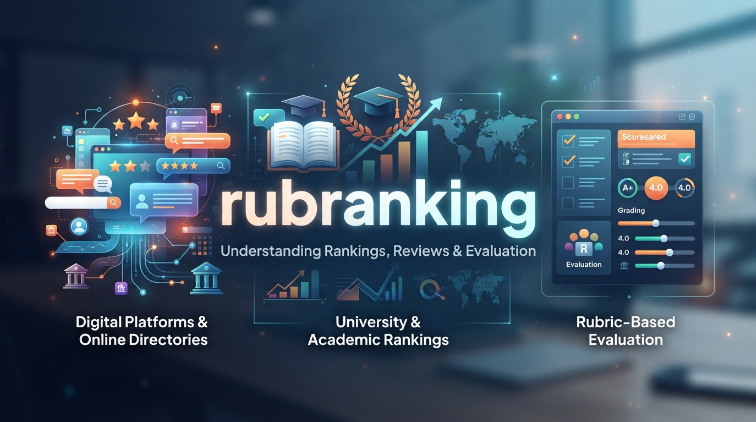
The term rubranking can point to very different subjects depending on where it appears. In one context, it may refer to the RubRankings online directory and review platform. In another, it can relate to Ruhr University Bochum and academic rankings, while in education it may describe a rubric-based ranking method. Understanding the surrounding context is therefore essential before assigning a single meaning to the term.
| Key Point | Overview |
|---|---|
| Primary interpretation | RubRankings online directory |
| Academic interpretation | Ruhr University Bochum rankings |
| Educational interpretation | Rubric-based evaluation |
| Main abbreviation | RUB |
| Context required | Website, university, or evaluation setting |
| Core concept | Ranking, reviewing, or structured assessment |
What Does Rubranking Mean?
Rubranking is not a universally defined technical term with one established meaning. Its interpretation depends largely on the source in which it appears.
The spelling can resemble a branded website name, an abbreviation connected with a university, or shorthand for a rubric ranking framework. These uses have little connection to one another, making context especially important.
For example, a web address containing “RubRankings” may refer to a specific online platform, while “RUB ranking” in an academic discussion may concern Ruhr University Bochum. In an educational document, “rub ranking” could instead describe a process where performance is evaluated against predetermined criteria.
RubRankings as an Online Platform
One prominent use of the term is associated with RubRankings, an online directory and review platform. The platform has been described as a peer-to-peer environment where users can find listings and share reviews related to adult-oriented local services.
Because this interpretation concerns an adult platform, its meaning is primarily tied to online directories, user-generated reviews, profiles, location-based listings, and community feedback.
Several characteristics distinguish this meaning from the academic and educational interpretations:
- It refers to a specific online platform or brand.
- Its content is based around listings and user reviews.
- The term is commonly written as “RubRankings” when referring to the platform.
- Its meaning has no direct connection with university league tables or classroom assessment.
This distinction matters because treating the platform name as an academic ranking term can produce an entirely different interpretation.
RUB and Ruhr University Bochum
Another possible meaning appears in German higher education.
RUB is commonly used as an abbreviation for Ruhr-Universität Bochum, also known in English as Ruhr University Bochum. When the abbreviation appears alongside words such as ranking, business, management, or BWL, the subject is likely university performance rather than an online directory.
Ruhr University Bochum is a major German research university located in Bochum, North Rhine-Westphalia. Its academic performance can be represented through different international and national ranking systems.
These rankings may assess factors such as:
- Research quality
- Academic reputation
- Teaching environment
- International outlook
- Research citations
- Industry connections
- Subject-specific performance
The exact position of a university can vary considerably between ranking organizations because each uses different methodologies.
Why University Rankings Differ
There is no single universal formula for determining the “best” university.
One ranking organization may place greater weight on research citations, while another may emphasize reputation surveys, international collaboration, teaching resources, or graduate outcomes. Subject rankings can also produce results that differ from overall institutional rankings.
For this reason, a reference to a “RUB ranking” should ideally identify the specific ranking provider and the year being discussed.
RUB Ranking and Business Studies
The connection becomes even clearer when RUB is paired with BWL, the German abbreviation for Betriebswirtschaftslehre, or business administration.
A ranking concerning RUB and BWL may therefore relate to the performance or reputation of Ruhr University Bochum’s business-related academic programs.
Business education rankings can consider areas such as:
- Curriculum quality
- Faculty research
- Employer reputation
- International partnerships
- Graduate outcomes
- Academic publications
- Student experience
These measures provide different perspectives rather than a single definitive judgment about educational quality.
Rub Ranking as a Rubric-Based Evaluation
A third interpretation is connected with rubric ranking.
A rubric is a structured evaluation framework that establishes specific criteria and performance levels before an assessment takes place. Instead of relying entirely on an evaluator’s overall impression, a rubric divides performance into measurable categories.
For example, a writing assignment might be evaluated according to:
| Criterion | Possible Focus |
|---|---|
| Accuracy | Factual correctness |
| Organization | Logical structure |
| Clarity | Ease of understanding |
| Evidence | Quality and relevance of support |
| Presentation | Overall communication |
A rubric-based ranking system can then compare results across individuals, projects, teams, or submissions.
How Rubric Ranking Works
A typical rubric ranking process follows several stages.
First, the evaluator establishes the criteria. Each criterion should describe something that genuinely matters to the outcome being assessed.
Second, performance levels are defined. These might range from beginning to advanced, or use numerical scores.
Third, each submission is assessed against the same standards.
Finally, the scores can be combined to produce an overall result or ranking.
This approach can make evaluations more consistent because participants are judged against predetermined standards rather than changing expectations.
Why Context Matters With Rubranking
The biggest challenge with the term rubranking is its ambiguity.
Consider three different sentences:
“RubRankings provides online listings and reviews.”
Here, the term functions as a platform or brand name.
“RUB ranking improved in the latest university assessment.”
In this sentence, RUB most likely refers to Ruhr University Bochum.
“The instructor used rub ranking to evaluate project quality.”
Here, the phrase could refer to a rubric-based evaluation system.
The surrounding words provide the clues needed to identify the intended meaning.
How to Identify the Correct Meaning
When encountering rubranking, examine the surrounding information before drawing conclusions.
A website address, domain name, or discussion of reviews points toward the online-platform interpretation. References to Bochum, Germany, BWL, university rankings, research, or academic reputation indicate the higher-education meaning.
Words such as criteria, scoring, assessment, performance levels, grades, and evaluation usually indicate a rubric-based framework.
The capitalization can also provide a useful clue. “RubRankings” may indicate a brand, whereas “RUB ranking” is more likely to describe a ranking associated with Ruhr University Bochum.
Challenges With Ranking Systems
Regardless of the context, rankings should be interpreted carefully.
Online review platforms depend heavily on the quality and reliability of user-generated information. Reviews can vary in detail, accuracy, and usefulness.
University rankings face a different challenge: methodology. A university can perform strongly in research while receiving a different position in a ranking that emphasizes teaching, reputation, or internationalization.
Rubric-based rankings also require careful design. Poorly defined criteria can create inconsistent results even when the scoring process appears objective.
A ranking is therefore best understood as a structured measurement rather than an absolute statement of quality.
The Future of Structured Rankings
Ranking systems are becoming increasingly data-driven across education, research, professional assessment, and digital platforms. Better data collection can make comparisons more transparent, but it does not eliminate the need for judgment.
The most useful ranking systems clearly explain what they measure, how scores are calculated, and what limitations apply to the results.
For users, students, educators, researchers, and organizations alike, understanding methodology is often more valuable than focusing only on the final position.
Final Thoughts on Rubranking
Rubranking has several possible meanings, and the correct interpretation depends entirely on context. It may describe the RubRankings online platform, a ranking associated with Ruhr University Bochum, or a rubric-based evaluation approach.
These meanings belong to separate fields and should not be treated as interchangeable. Checking the surrounding terminology, source, capitalization, and subject matter usually makes the intended definition clear.
Ultimately, whether the discussion involves an online directory, university performance, or structured assessment, the key is to understand exactly what is being ranked, which criteria are being used, and how the resulting information should be interpreted.
Frequently Asked Questions About Rubranking
Is rubranking a single standardized term?
No. The term can refer to different concepts depending on context, including an online platform, university rankings, or rubric-based evaluation.
What does RUB mean in university rankings?
In a German academic context, RUB commonly refers to Ruhr-Universität Bochum, or Ruhr University Bochum.
What is a rubric ranking system?
A rubric ranking system evaluates performance using predefined criteria and scoring levels. It is designed to make assessments more structured and consistent.
Why can university rankings vary?
Different ranking organizations use different methodologies. They may prioritize research, reputation, teaching, citations, internationalization, or other indicators.
How can I determine which meaning of rubranking is intended?
Look at the surrounding words and source. References to websites and reviews suggest the platform meaning, while university terminology points toward Ruhr University Bochum. Educational assessment terms usually indicate rubric-based ranking.


